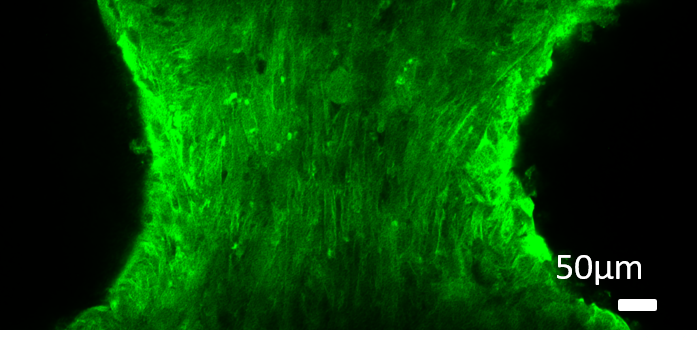
Muscle tissue is characterized by a remarkable hierarchical architecture, spanning from individual protein assemblies to highly organized bundles of aligned myotubes. Myotubes are syncytial cells formed through the fusion of thousands of muscle precursor cells, making cell alignment and fusion key steps in muscle tissue formation and differentiation. Understanding how mechanical forces drive this transition is at the heart of our research.
We aim to reproduce and control this process by mechanically constraining multicellular aggregates. Using a custom-built stretcher, we can impose large and controlled deformations, extending multicellular aggregates by up to 50%, and investigate how these physical constraints influence cell alignment, collective organization, and differentiation.
To further control the mechanical environment experienced by cells, we use magnetically responsive cells confined between two magnets, one of which can be displaced to generate controlled mechanical forces. The resulting deformation promotes cell alignment and can consequently modulate cell differentiation. In particular, periodic mechanical stimulation has been shown to drive stem cells towards cardiac progenitor differentiation [1]. These approaches provide a framework to investigate how cell-generated forces and externally applied mechanical constraints govern the emergence and fate of active tissues.