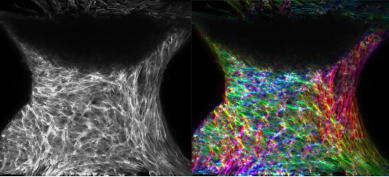
We investigate living tissues as active matter: dynamic systems in which cells continuously generate forces, reorganize their environment, and collectively shape tissue architecture. Our research focuses on how cellular activity and mechanical interactions give rise to tissue-scale organization, and how these processes influence cell differentiation and tissue function.
A major focus of our work is the emergence of 3D muscle tissues from initially disordered multicellular aggregates. In a recent study, Nagle et al. showed that controlled mechanical deformation can drive the self-organization of muscle precursor cells into highly aligned and differentiated tissues. Using a magnetic stretching device, we demonstrated that tissue-scale mechanical constraints promote cell alignment and muscle differentiation, revealing how mechanical forces can act as instructive signals for tissue development.
This work illustrates our broader interest in mechanobiology and active tissue organization: cells are not passive components of a tissue, but active agents that generate forces, sense mechanical cues, and collectively remodel their environment. We combine mechanical stimulation, magnetic manipulation, quantitative imaging, and biophysical approaches to understand how these feedback mechanisms control tissue organization and cell fate.
Our goal is to uncover the physical principles governing the self-organization and adaptation of active tissues, and to develop strategies to mechanically control tissue formation and function. This approach also provides a framework for investigating pathological tissue remodeling, including the role of mechanics in tumour invasion and progression.